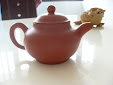
In the beginning there was China and then there was the tea and the teapots.
I've lived in China about a year now and hadn't had much to do with Chinese tea until a little while ago. My wife Crystal teaches English to some adult students and one of those student was Linda, who with her husband and her family run a teashop and other shops in the city of Zunyi where we live.

Linda invited us to her shop and I was formally introduced to the Chinese tea ceremony. Incidentally the tea ceremony was started by the Chinese and only copied by the Japanese much later; however the Japanese styalised it more. I was captivated by her shop and the great array of delightful teapots and tea ceremony goods therein. It was then I became besotted by the idea of drinking tea in this way and all that went with it.

At the end of our pleasurable tea drinking evening, Linda presented us with a gift of special ceremonial tea tray, teapot, cups, glass jug and a little tea. It was a kind gesture. The following day we returned to purchase various quantities of tea from her - Oolong, white tea, green tea and Pu-erh tea (black tea). I wanted to aquaint myself with all the teas. Oh yes, and I also bought some tea pets! Talk more about them later.
I've started to write this blog to share with you the pleasure and spirit of drinking Chinese tea in this special way.
History of drinking tea in China
The origins of drinking tea appear to be lost in the mists of time but there is no doubt that it goes back thousands of years. Below are some accounts about how tea was discovered and all are different but all point back to tea being discovered and drunk around five thousand years ago and there is no doubting the origins of tea are from China. Although tea production has spread to other parts of Asia, notably India where most of the tea we drink comes from, the origins of the plant which all tea is produced Camellia sinensis comes from China. It is perhaps fitting that today in the U.K. where we drink great quantities of tea, mostly from India, that from mugs and cups from which we drink it, we call china.
'Chinese people are believed to have enjoyed tea drinking for more than 4,000 years. Legend has it that Yan Di, one of three rulers in ancient times, tasted all kinds of herbs to find medical cures. One day, as he was being poisoned by some herb he had ingested; a drop of water from a tea tree dripped into his mouth and he was saved.'
http://www.travelchinaguide.com/intro/cuisine_drink/tea/
'While references to tea in Chinese literature go back approximately 5,000 years, the origin of tea's use as a beverage is unclear. Ancient folklore places the creation of the brew at 2737 BC, when a camellia blossom drifted into a cup of boiled drinking water belonging to Emperor Shen Nung. However, most scholars credit a reference found in Erh Ya, an ancient Chinese dictionary, dated about 350 BC.
Originally, tea was valued for its medicinal qualities. It has long been known that tea aids in digestion, which is why many Chinese prefer to consume it after their meal. (Another interesting side effect for smokers is that tea hastens the discharge of nicotine from the body).'
http://www.travelchinaguide.com/intro/cuisine_drink/tea/
Another story goes that 'tea was first discovered by the Chinese Emperor Shennong in 2737 BC. It is said that the emperor liked his drinking water boiled before he drank it so it would be clean, so that is what his servants did. One day, on a trip to a distant region, he and his army stopped to rest. A servant began boiling water for him to drink, and a dead leaf from the wild tea bush fell into the water. It turned a brownish color, but it was unnoticed and presented to the emperor anyway. The emperor drank it and found it very refreshing, and cha (tea) was born.'
The history of tea can best be summed up in this article.
'Historically, tea‘s origins date back to around 2700 BC. It is thought to have first been discovered in the mountainous areas of China‘s far western Sichuan and Yunnan provinces. It was originally taken as a detoxifying medicine though it grew to great social prominence during the Tang (620-907 AD) and Song (960-1279 AD) Dynasties. In addition to tea‘s attributed health benefits, the high level of "tea culture" was appealing to people outside of China as well. Since the fifth century AD, tea has been exported by land and sea throughout Asia before it reached Europe in 1610. It was Dutch traders that first brought tea to Europe but the British who greatly developed it, transplanting it to India in the early 1800‘s.' http://english.china.com
The history of tea points to the fact that originally it was used purely as a medicinal drink before it became popular as an every day refreshing drink but tea is still considered to have health giving properties, although the claims vary widely. Visits Benefits of Drinking Tea:-
http://en.wikipedia.org/wiki/Potential_effects_of_tea_on_health
http://www.green-teas-guide.com/benefits-of-green-tea.html
Other references
http://www.chinesefood-recipes.com/food_articles/chinese_tea.php


 Posts
Posts